A Quiet Start to the Year, Amid Familiar Conditions
Vancouver’s housing market opened 2026 on a subdued note, echoing the trends that defined much of 2025. Home sales totalled just 1,107 in January, marking a 28.7% decline from the same month last year and placing activity 30.9% below the 10-year seasonal average. While the drop may seem stark in isolation, it reflects a continuation of momentum from a historically slow 2025 - now recognized as the lowest annual sales total in over two decades.
On the supply side, 5,157 new listings hit the MLS in January, down slightly year-over-year, but still well above the 10-year average. Total active listings reached 12,628, representing a 9.9% increase over January 2025 and sitting a substantial 38% higher than typical seasonal levels. This elevated inventory continues to offer buyers a broad range of options, especially as pricing adjustments persist.
The sales-to-active listings ratio dipped to 9.1%, firmly below the 12% threshold that typically signals downward pressure on prices. Detached homes led the slowdown with a ratio of just 6.7%, while attached homes and apartments followed at 11.1% and 10.3%, respectively - all buyer-favouring conditions.
In the words of GVR Chief Economist Andrew Lis, "January’s numbers aren’t unexpected - they’re a reflection of where the market left off in 2025. Momentum takes time to rebuild, and we’re likely seeing the early stages of that slow evolution.”
Price trends in January reflected this persistent supply-demand imbalance. The composite benchmark price for all residential properties dropped to $1,101,900—down 5.7% compared to January 2025 and 1.2% lower than December’s figures. These declines were mirrored across all housing types.
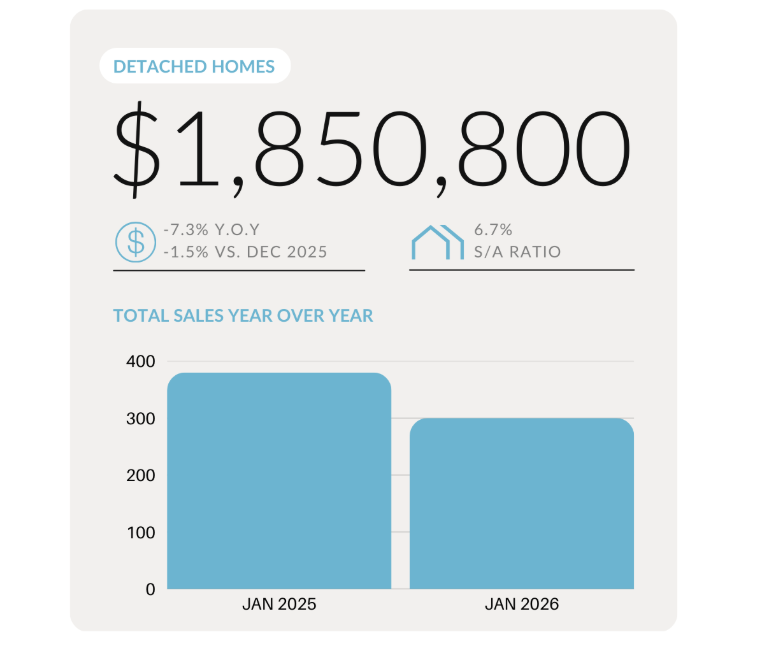
Detached homes continued to feel the greatest pressure in January. Sales in this segment totalled 300, down 21.1% from the same month last year. The benchmark price for a detached home declined to $1,850,800, representing a 7.3% year-over-year drop and a 1.5% decrease compared to December. With a sales-to-active listings ratio of just 6.7%, detached homes remain firmly in buyer’s market territory, as higher price points and cautious sentiment limit demand despite improved borrowing conditions.
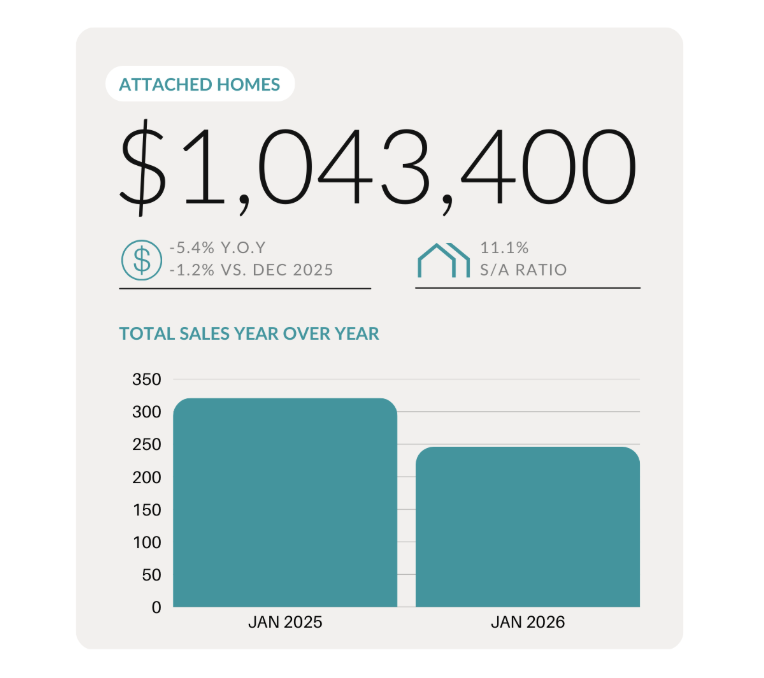
The attached home segment showed slightly more resilience but continued to soften overall. Townhouse sales reached 246 in January, down 23.4% from January 2025. The benchmark price now sits at $1,043,400, reflecting a 5.4% year-over-year decline and a 1.2% drop month-over-month. The sales-to-active listings ratio of 11.1% places this segment just below the threshold associated with price stability, suggesting demand remains muted but closer to balance than in the detached market.
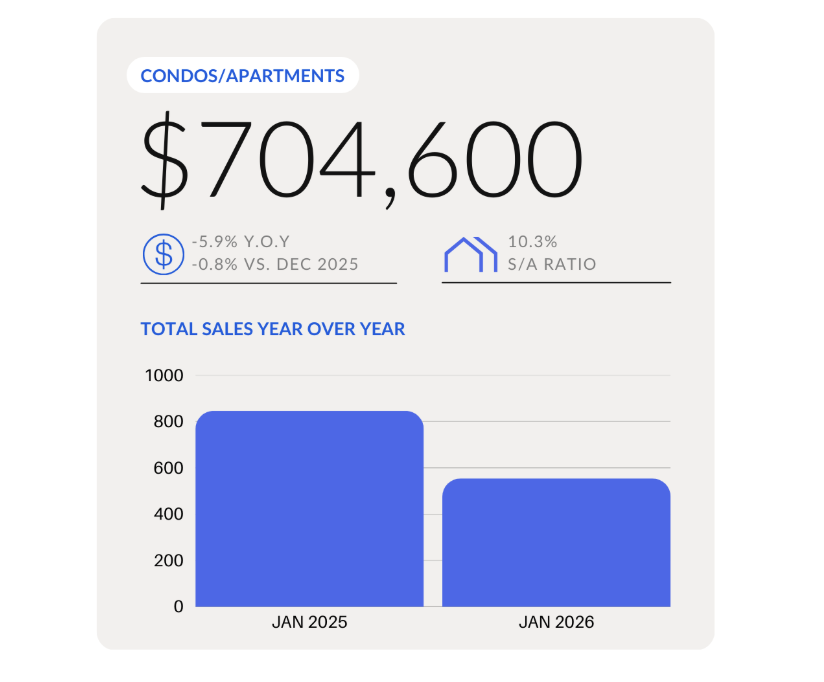
Condos experienced the sharpest decline in sales volume with just 554 units sold in January, a 34.5% decrease compared to the same month last year. The benchmark price for condos fell to $704,600, down 5.9% year-over-year and 0.8% from December. While apartments remain the most accessible entry point for many buyers, elevated inventory and cautious investor activity continue to weigh on demand.
A Market In Transition: Will 2026 Repeat 2025?
““As consumers adjust to the ongoing backdrop of political and economic uncertainty, we expect a degree of pent-up demand to re-enter the market at some point. Whether it will happen in 2026 remains an open question, and we’ll be watching the market closely for signs of improvement.”
Andrew Lis, GVR Director of Economics and Data Analytics”
GVR’s 2026 forecast anticipates continued price stability, above-average inventory, and subdued sales activity- a pattern that largely echoes the dynamics we saw throughout 2025. While not a dramatic departure from the status quo, this projection suggests that the market may be settling into a new rhythm, after years of volatility.
That said, there are early signs of cautious optimism. Borrowing costs are now meaningfully lower than they were a year ago, and sellers remain highly active, bringing a steady stream of listings to market. Combined with improving affordability in some segments and a more balanced playing field for buyers, this could set the stage for a gradual resurgence in demand.
While it's too early to call a turning point, the coming months will offer important clues as to whether 2026 will remain a mirror image of last year - or mark the start of a slow but steady shift.
For those considering selling, reach out today for a complimentary home equity health check to assess your property’s value and explore your options in this evolving market.